Wednesday, July 22, 2009

Hukum Ohm

Hukum Ohm
States that "the voltage across the various types of materials are proportionate with the straight flow of the stream." Mathematically expressed by:
Hukum Ohm

Ohm's law formula can be derived as follows:
Hukum Ohm

V is the voltage (in volt), I is the current that flows (in ampere) and R is resistansi or obstacles (in ohm, Ω) which is 1 ohm value is equal to 1 volt / ampere.
Resistansi is a measure of how large flow by preventing elements. Reverse of resistansi (1 / Ω, S) is called with konduktansi (G). Konduktansi is a measure of how good flowing currents akan allowed in the series. The mathematical relationship between resistansi and konduktansi stated with
Hukum Ohm
Example 1
Determine the current that flows in the series when a 12 volt battery is connected with a resistor of 2 Ω!
Answer:
Hukum Ohm
Example 2
Specify resistansi of 44 fluorescent light wall W, which when connected with the voltage of 220 V will then flow currents of 200 mA!
Answer:
Hukum Ohm

READMORE...

Arus |Tegangan|Daya||Energi Listrik

  • Arus listrik|Electric current (I)
Electric current states that the number of load flow in a certain direction on a series of electrical elements of each unit of time. Mathematically expressed by:


with,
I: electric current (in ampere)
Q: electric load (in coulomb)
t: time (in seconds)
Than the electric current magnitude have also have a direction (the direction indicated by arrow), which describes the direction of moving cargo electricity.


Tegangan|Electric current (V)
Electric current Work is needed to move the load of 1 coulomb positive from one point to the tip of the point the other end. Mathematically expressed by:


with,
V: voltage (in volt)
Q: electric load (in coulomb)
W: electrical energy (in Joule)

Usually termed as the voltage potential difference between the two dots on a series of elements. For states marked with a voltage algebra plus-minus polarity (+,-) that point with the other point. As an illustration shown in the picture below:


A point means is 5 volt more positive than the point B or point A is -5 volt more negative than point B.

  • Daya|Power (P)
Power the rate of electrical energy per unit time to move a load of 1 coulomb through a series of elements. The energy absorbed is proportional to the number of cargo that moved every second (or flow) and comparable with the energy needed to move one coulomb through a series of elements (or tension). Mathematically expressed by:


From the above formula can be derived the power formula as follows:


Sign agreement to current, voltage, power, and concluded in the following picture


Image shows an edge if the element is V volt more positive towards the end of the other point, and if I enter a flow of elements through the end of the positive, then the power P = VI is absorbed by these elements and vice versa.

  • Energy (W)
Energy Is the result of the multiplication with the power of time. Mathematically expressed by:

READMORE...

Analisis Nodal/Simpul/Titik -Analisa Rangkain Elektronika

Analisis Nodal/Simpul/Titik Untuk mempermudah Analisa Rangkain Elektronika

Nodal / Simpul /titik Analysis By using this method, we will first obtain the size of the voltage on each of a series in which later can be used to explore the amount of electricity the other.

Stages to implement a Nodal / Simpul / Titik Analysis is this:
1. Determine the amount of twist in the series.
2. Choose a Simpul reference mark and the rest with a certain voltage, such as V1, V2, V3 and so on.
3. Determine the direction of flow on each knot. On a note that is not the directions, the directions are usually chosen exit / leave the simpul. Rename the current I1, i2, I3, and so on.
4. Apply Kirchoff current law at every twist in the simpul, except reference. Consider that all flows that do not know the directions, will leave every simpul.
5. Complete equality of linear simultan

Example
From the following series, specify the size of the voltage is in each simpul it!
Analisis Nodal/Simpul/Titik

Answer:
Determine the number of simpul:
Analisis Nodal/Simpul/Titik

Simpul V1:
Analisis Nodal/Simpul/Titik

Simpul V2:
Analisis Nodal/Simpul/Titik

Expressed in the form of a matrix:
Analisis Nodal/Simpul/Titik

READMORE...

Tuesday, July 21, 2009

Analisis Loop/Mesh Pada Rangkaian Elektronika

Analisis Loop/Mesh Pada Rangkaian Elektronika

Stages to implement the Loop Analysis / Mesh is this:
1. Determine the direction of flow in each loop in the series. Usually selected with the clockwise direction.
2. Determine the polarity of each element in the series.
a. In the source: cash flow from the polarity (-) to the polarity (+)
b. In the burden: cash flow from the polarity (+) to the polarity (-)
3. Apply Kirchoff Voltage Law in each loop is in series, so that equality of the number of the loop.
4. Complete the simultaneous equation.

Example
Decide which is the current flowing in each loop of the following series!
Analisis Loop/Mesh

Answer:
specify the first flow direction in each loop. We select the direction of the finger so that it becomes a series:
Analisis Loop/Mesh

By applying Kirchoff voltage law to each loop is
Analisis Loop/Mesh
Analisis Loop/Mesh

With substitution and eleminasi second loop equation is:
Analisis Loop/Mesh

Equality of loop I1
Analisis Loop/Mesh

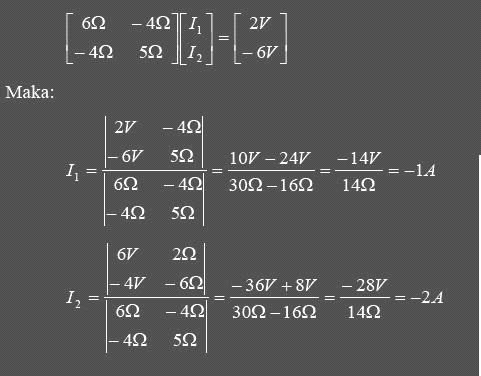
Simultans that equality can also be obtained by using matrix algebra with the first claim to the loop equation in the form of a matrix as follows:
Analisis Loop/Mesh


READMORE...

Transformasi Sumber

Transformasi Sumber

When we apply a method to analyze a series of DC, may be necessary to change the source of flow into voltage source or voltage source into a source flow.

Not any source can be transformed. A voltage source in series with the new resistans can be transformed into a source of flow in parallel with resistans. Instead of a flow in parallel with the resistans transformation can be a source of voltage in series with the resistans. In general, how to change the power source into a source of other types shown in the picture below:
Transformasi Sumber

  • Example
with the Sources Transformation, Change voltage source in the image below into the source flows!
Transformasi Sumber

Answer:
Transformasi Sumber

The results shown in the picture below:
Transformasi Sumber

  • Example 2
with the Sources Transformation, Change flow Source on the images below are a source of tension!
Transformasi Sumber

Answer:
Transformasi Sumber

The results shown in the picture below:
Transformasi Sumber

READMORE...

Teorema Thevenin - Analisis Rangkaian Elektronika

Teorema Thevenin untuk menganalisis Rangkaian DC

Thevenin theorems states that any two of the series can be converted into an equivalent set of which consists of a voltage source thevenin (ETH) and a resistans equivalent thevenin (RTH) is in series with voltage source thevenin.


Steps to find the rope thevenin is:
1. Specify two of the series who want to search string thevenin it.

2. Determine the amount of voltage thevenin (ETH), namely the voltage between two terminals which want to search a series of rope thevenin it.

3. Specify the size of the resistans thevenin (RTH) is equivalent resistans a review / calculated from the two-terminal series who want to search string theveninnya. At the time resistans thevenin determine this, all sources should be eliminated. Voltage source into a series of short relationships and sources of flow into a series of open relationship.

4. Strand thevenin its image.

Example
Specify thevenin strand of a series that is connected to resistor R3 on the image below!
Teorema Thevenin

Answer:
specify the first series who want to search thevenin its rope, as the picture below:
Teorema Thevenin

Then specify the ETH:
Teorema Thevenin

ETH is the same as the voltage between the terminal R2
Teorema Thevenin

Determining RTH:
Eliminate all sources used in the series. Thus the voltage source into a series of short Hubung (V = 0). Series is to be:
Teorema Thevenin

then, its thevenin strand shown in the picture below
Teorema Thevenin

READMORE...
 
Skema Rangkaian Elektronika